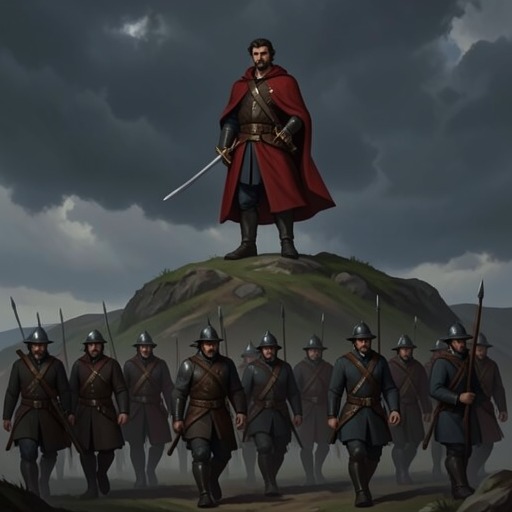
Seven Captures and Seven Releases of Meng Huo
The Romance of the Three KingdomsSeven Captures and Seven Releases of Meng Huo is Kong Ming’s campaign to secure the submission of the southern tribes by repeatedly capturing and releasing their leader, Meng Huo. Its decisive premise is that military victory cannot by itself produce lasting allegiance: Kong Ming makes each battlefield success an opportunity to test whether his opponent will yield willingly, and finally wins Meng Huo’s submission through a combination of strategy, mercy, and repeated proof of Shu’s power.
Purpose and Principle
The campaign turns on a distinction Kong Ming explains to his commanders after Meng Huo’s first capture. Kong Ming says he can capture the rebel leader whenever he wishes, but that the tribes will only be won over by capturing their hearts, not merely their bodies. His officers are not pleased by this approach, which prolongs the campaign and repeatedly releases a dangerous enemy. Yet the method establishes the measure by which the story judges success: an imprisoned chief is not the same as a people who will no longer rebel.
That principle does not make the campaign bloodless or eliminate deception. Meng Huo’s forces are defeated in ambushes, and Kong Ming’s tactics rely on luring opponents into danger and manipulating their expectations. But the repeated release of prisoners is as important as the repeated capture of their leader. When Meng Huo is first brought before Kong Ming after his army is routed, Kong Ming orders captured soldiers released, observing that they were ordinary people forced into service and that their families feared for them. The men return home relieved and praise Kong Ming. The episode sets a pattern: force defeats the army, while clemency is made visible to the people it has defeated.
The First Three Captures
Meng Huo’s first capture follows a battlefield ruse. After a challenge between the Man warrior Mangyachang and Wang Ping ends with Wang Ping apparently defeated and fleeing, Meng Huo advances and is drawn into an ambush. Wei Yan captures him as his troops are routed, with many killed and others taken prisoner. Kong Ming receives the captive amid a display of Shu’s resources, but then orders the captured soldiers freed. When Meng Huo refuses to submit on the ground that he was trapped, Kong Ming answers that he will let him go. Meng Huo promises to raise fresh troops and fight again, adding that he will submit if captured next time. Kong Ming has his shackles removed and provides food, drink, clothing, and a horse before releasing him.
The release sends Meng Huo back to his people with a story that strengthens rather than diminishes his reputation. He falsely claims to have killed guards and escaped from his tent, and his followers are delighted by the tale. More than a hundred thousand men soon gather to support him. He withdraws the boats from the north bank of the river, fortifies the south bank with a wall and watchtowers, and plans to wear down Shu’s army in the summer heat. The contrast is pointed: Kong Ming’s mercy has spared Meng Huo, but has not yet persuaded him; the captive turns release into a new opportunity to rally resistance.
At the second capture, Kong Ming again invokes Meng Huo’s promise. Meng Huo objects that he was betrayed, so he does not consider himself bound to submit. When Kong Ming asks what would follow from another release, Meng Huo says he will return with a new army, as a leader of the tribes must, but will submit if captured again. Kong Ming frees him with food and drink. The exchange makes the terms of the contest increasingly explicit: each defeat is followed not by an imposed settlement but by another pledge, which Meng Huo qualifies or refuses to honor.
The third capture comes when Meng Huo and his men attack Kong Ming’s camp at night, intending to exploit an apparent opening. They find the camp deserted and men inside it drunk and drugged; Kong Ming has anticipated the attack and springs an ambush. Meng Huo is captured again, most of his soldiers surrender, and Kong Ming orders the prisoners released. Meng Huo argues that he lost because Kong Ming tricked his brother, not because he himself had been beaten, and blames Heaven rather than his opponent. Kong Ming sighs and lets him go once more. Meng Huo promises that if he is defeated in a proper battle next time, he will submit and never resist again. Kong Ming even advises him to study military texts and prepare fully before returning.
Repeated Defiance and Expanding Tactics
The next cycle tests both Meng Huo’s promises and Kong Ming’s patience. Kong Ming crosses the Western Er River with his army, establishing fortified positions and three forts on the south side. When Meng Huo appears with his forces, Kong Ming rides forward in his carriage, in a silk headband, white clothing, crane-feather cloak, and carrying a feather fan; Meng Huo faces him in rhino-skin armor with a shield and sword. Despite his commanders’ calls to fight, Kong Ming orders a retreat into the forts. The campaign continues to turn on planned encounters in which appearances, expectations, and the decision to advance can be as consequential as direct combat.
After the fourth capture, Kong Ming pardons and releases the soldiers and urges Meng You, Meng Huo’s brother, to try to restrain him. Meng Huo remains defiant and threatens revenge, even when ordered to be executed. Kong Ming discovers that he will attempt resistance again but promises to submit if defeated once more, and releases him. Meng Huo and Meng You then seek refuge in Bald Dragon ravine, trusting its two approaches: one is blocked by fortifications, while the other crosses a desolate route past four deadly springs. Their confidence in the refuge does not end the contest; it shifts the struggle toward terrain, heat, and the survival of an invading army far from its base.
When the narrative resumes with the sixth capture in view, Meng Huo, Meng You, and King Duosi have returned to their lands, especially the Silver Pit hills, where three rivers meet at Sanjiang. The account describes the ancestral temple of the Man rulers and customs distinct from those of Shu, including animal and human sacrifice, the use of shamans rather than doctors, immediate execution for crimes, free barter in markets, and different practices of marriage and food. Meng Huo gathers about a thousand surviving men and seeks help from King Mulu of the Bana valley, famed for commanding wild animals. King Duosi fortifies Sanjiang. Kong Ming sends Wei Yan and Zhao Zilong to reconnoiter what appears to be a weak point, where they meet a storm of poisoned arrows and withdraw. The apparent success encourages the defenders to relax their guard, as Kong Ming intended.
King Mulu’s forces bring a supernatural dimension to the contest. He summons a storm and wild creatures against Kong Ming’s army. Kong Ming calmly shakes his fan, and the storm turns back toward the Man army. He then advances statues that, when ignited with gunpowder, roar and belch flames. The animals flee in terror, trampling or killing Man soldiers; the army is defeated, King Mulu is killed, and only part of the force escapes. Afterward, a brother-in-law brings Meng Huo and his family to Kong Ming as supposed hostages, but the arrival is an assassination plot. Kong Ming has Zhang Ni and Ma Zhong hide troops by his tent, and they seize the armed party. He reminds Meng Huo that he had promised to submit if captured in his own lands. Meng Huo refuses, insisting that he came to bring death and has not been beaten in battle. Though exasperated after capturing him for the sixth time, Kong Ming releases the captives after Meng Huo promises to submit if caught a seventh time.
The Seventh Capture and Submission
With his fortifications destroyed and his forces reduced to roughly a thousand men, Meng Huo turns to the Wugu tribe. Its chief, Wutugu, relies on rattan armor repeatedly soaked in oil, which is described as impervious to arrows and swords and buoyant in water. The Shu army is lured into Serpent Winding valley by men pretending to have escaped captivity and offering to escort Meng Huo to Wutugu’s triumph. Once Meng Huo and his entourage enter the valley, they realize they have been trapped. Zhang Ni and Ma Zhong seize Meng Huo, his wife, and the others. Meng Huo briefly breaks free, but Kong Ming blocks his path in his carriage, and Ma Dai catches him.
The seventh capture changes the meaning of the repeated release. Kong Ming tells the captives that he despises having had to use such tricks and that their consequences will weigh on him; he also calls the possible extermination of the tribes a terrible burden. Meng Huo is given food and drink in a separate tent, and an officer tells him that Kong Ming is too embarrassed to see him and that he is being released to gather another army. This time Meng Huo does not leave. In tears, he acknowledges that he has been captured and released seven times, calls the experience unprecedented, and says that even as a barbarian he understands morality and righteousness. He and his followers crawl to Kong Ming’s tent; Meng Huo bares his upper body and kneels, following his tradition to show readiness for punishment.
Kong Ming asks directly whether Meng Huo now submits. Meng Huo, sobbing, answers that his people will remain grateful for generations because Kong Ming spared them, and therefore they must submit. The conclusion differs from the earlier promises: submission is no longer deferred to a future capture or rejected as the result of betrayal. It is expressed as recognition of repeated mercy and the moral debt that mercy has created. Kong Ming and Meng Huo celebrate late into the night, and Kong Ming appoints Meng Huo ruler over the lands conquered by Shu. The Man people rejoice, leaping and dancing.
Narrative Significance
The sequence is constructed as a recurrence with variation. Captures are followed by challenges to the legitimacy of the defeat, fresh pledges, and releases; each cycle makes the terms harder to evade while demonstrating that Kong Ming’s victory does not depend on keeping Meng Huo in chains. The number seven supplies the campaign’s formal destination, but its force comes from the accumulated differences between the episodes: soldiers are freed after defeat, Meng Huo’s excuses shift, Shu’s methods adapt to changing terrain and allies, and the final release is the one he refuses to accept as mere escape.
The story presents persuasion and coercion together rather than treating them as opposites. Kong Ming defeats armies by ambush, deception, gunpowder, and careful use of terrain, yet he repeatedly spares the prisoners and ultimately gives the conquered leader authority over the lands Shu has taken. His declaration that exterminating the tribes would be a terrible burden makes the stakes of the campaign explicit: victory is not framed simply as destruction, but as an effort to end rebellion without destroying the people whose allegiance the state seeks. Meng Huo’s submission, in turn, is represented not as the disappearance of his identity but as a public recognition of moral obligation. The campaign’s political resolution thus rests on both Shu’s demonstrated power and the mercy that Meng Huo finally understands as a claim upon him.